Top trade of the month: Adam caught a sharp sell-off on the DAX and turned the reversal into EUR 3,076
How do you trade a reversal after a sharp sell-off without catching a falling knife? On the DAX, Adam waited for the price to react at support and for buyers to confirm their return. He then closed the position at the previous resistance. The result: EUR 3,076. We break down his trade step by step.
Summary
- Adam went long on the DAX index and made EUR 3,076 on the trade.
- He didn't enter during the sharp drop. He waited for the price to reach the 25,970–26,000 area, where buyers had shown up before.
- The entry signal was a candle with a long lower wick, followed by a series of green candles. Together they showed that sellers could no longer hold the price down.
- He closed the position in the 26,060–26,070 area, where the sell-off had started. Shortly afterwards, the market dropped again.
- The main lesson: don't try to catch the exact bottom or top. Enter only after confirmation and exit at a logical price level.
A sharp sell-off doesn't necessarily mean the start of a further decline. Sometimes it's an opportunity for a trader who can spot when selling pressure is running out and a reversal is coming. That's exactly the situation Adam bet on in his trade on the German DAX index. After a significant price drop, he waited for the first signs that lower prices were being rejected, and then for the reversal to be confirmed. The result was a long position that ultimately earned him EUR 3,076.
What makes Adam's trade interesting is that he didn't enter the market during the sharp drop itself. Instead, he let the market reach an important price area first, watched how buyers reacted, and only then took advantage of the change in short-term structure. Let's look at what happened before his entry, why a BUY made sense from a technical analysis perspective, and why Adam decided to exit exactly where he did.
What happened before the entry?
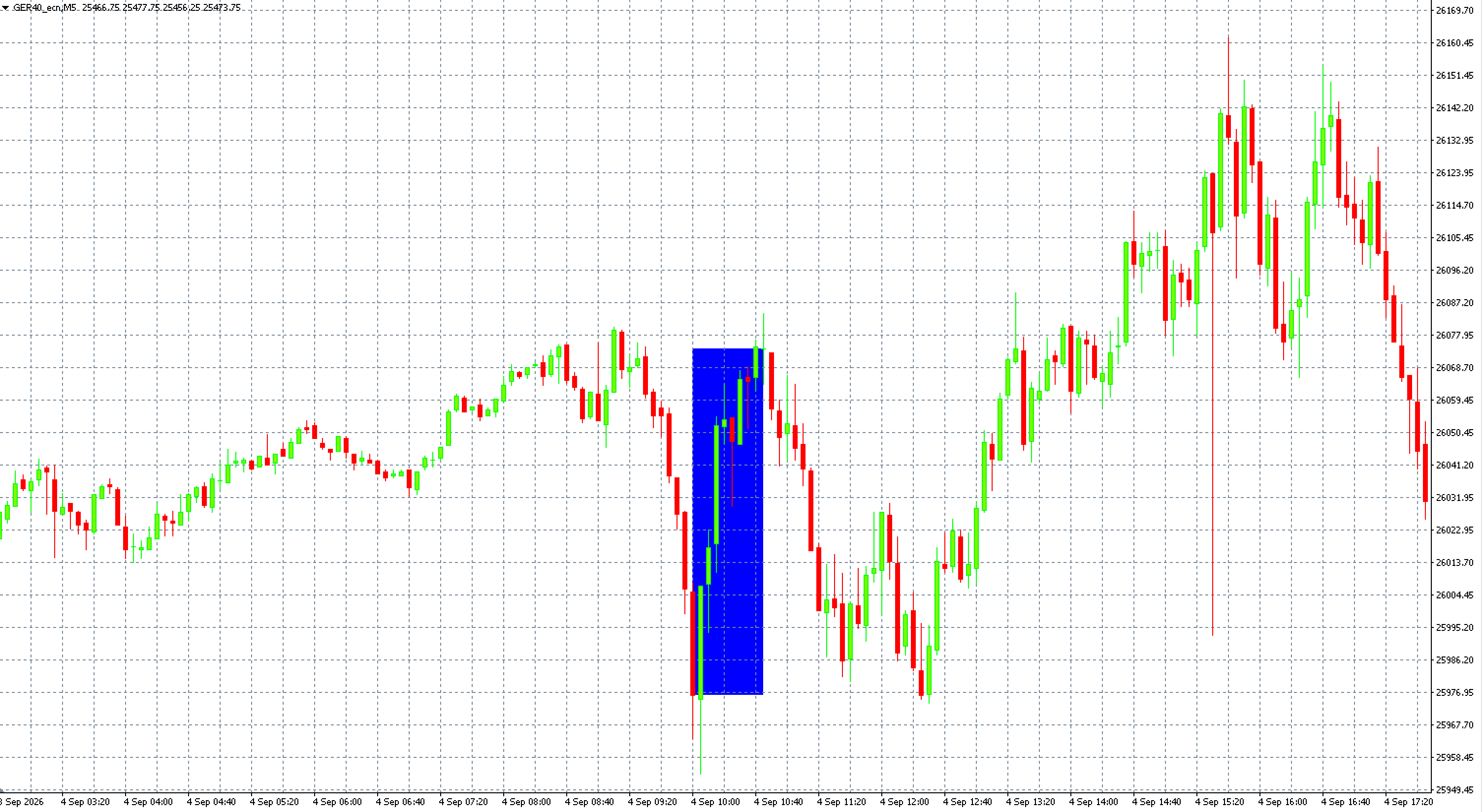
In the first part of the period, the DAX had a fairly clear upward structure. The price was gradually making higher highs and higher lows, and during the morning it climbed to around 26,070 points. That's where sellers started to take control. A fairly quick decline followed, pulling the index significantly lower within just a few candles.
For Adam, though, the drop alone wasn't a reason to jump straight into a BUY position. If anything, it could signal that the market was oversold in the short term and that the price was approaching an area where buyers might step in again. On top of that, the sell-off didn't keep printing new lows without any reaction from the market. The price reached roughly the 25,970–26,000 area, where a clear rejection of lower prices began to form.
This area is very interesting from a price action perspective. Buyers had been active there in the past, and the sharp drop into this zone meant the market had wiped out a significant part of the previous rally in a short time. From a trader's point of view, this created a potential support, or demand, zone. The key point, however, was that Adam didn't simply bet on the idea that "the price has fallen enough". He waited for the market to react.
Entering the market
Adam opened his BUY position on the DAX at the moment the sharp sell-off began turning into a short-term reversal. Near the bottom, you can see a strong price reaction: a strong red candle was followed by a candle with a long lower wick, after which buyers gradually took over. That's an important signal, because a long lower wick in this situation shows that sellers failed to hold the price at its lowest levels.
A series of green candles followed, gradually pushing the price back above 26,000 points. At the same time, the market's short-term structure changed. After the sharp new low, higher lows started to form, and the price then attempted to return to the area where the previous sell-off had begun. Adam was able to use a combination of several technical factors: the previous rally, the sharp sell-off into support, the rejection of lower prices, and the bullish reversal pattern that followed.
The timing of the entry is also worth noting. Adam didn't try to catch the absolute bottom, which is crucial in trades like this. Trying to buy right in the middle of a sharp drop would have been much riskier, because the market could have kept falling. Instead, Adam let the price stabilise first and waited for the price action itself to show him that the situation was really changing. Only the green candles that followed and the return of buyers gave him enough confirmation to go long.
In other words, this wasn't just a bet that the DAX was "too low". It was a trade on a short-term reversal after a sell-off, backed by the price reaction at support and a shift in intraday momentum. That's the essential difference between a systematic reversal trade and simply catching a falling knife.
Trade stock indices with zero commissions — start today!
Exiting the market
After the entry, the DAX rose quickly and within a relatively short time returned to around 26,060–26,070 points. That's where Adam closed his position. Technically, it's a logical area to take profit, because it was the level where the earlier rally had hit resistance and where the sharp decline had started.
Adam had no reason to assume the market would automatically continue to new highs. After a very fast bounce off support, the price was back in the resistance area and started showing signs of hesitation. The chart shows alternating green and red candles, upper wicks, and an inability to push meaningfully above the previous local highs right away. That's exactly the kind of situation where it makes sense to close part or all of a position, rather than leave profit already made exposed to unnecessary risk.
And Adam's exit timing turned out to be very good. Shortly after he closed the trade, the DAX did head lower again, followed by another, more significant decline. He didn't need to wait for the absolute peak of the move. He captured a substantial part of the reversal from support to resistance and left the rest to the market.
This is one of the key principles of successful intraday trading: you don't have to hit both the bottom and the top. What matters far more is trading an area where the potential reward is attractive relative to the risk, and then closing the position once the price reaches a logical technical target.
The result? EUR 3,076.
Adam's DAX trade was built mainly on a combination of support, the rejection of lower prices, a change in short-term price structure, and the subsequent return to resistance. While the first part of the move might have looked like a pure sell-off at first glance, Adam was able to spot that selling pressure was potentially running out. He didn't go against the market without confirmation. He waited for the reaction at support and for buyers to return.
He also managed his exit well. After a strong bounce from around 25,970 points, the price returned to the previous resistance at 26,060–26,070 points. There, further upside was far less clear, and the price action that followed confirmed his decision to close the trade. Adam turned a short-term reversal on the German stock index into EUR 3,076, without trying to squeeze every last point out of the market.
Curious what's inside?
Create a free account and explore the Fintokei zone — loyalty rewards, dashboards, refer a friend and more. No challenge required.

My job is to make sure everything works exactly as it should for our traders. After testing ProTrader Swing, I switch to real swings with kettlebells at the gym, or dive into digital illustration and video games to recharge. Favorite platform: cTrader. Favorite challenge: ProTrader Swing.