Best Trading Strategies for Virtually Funded Accounts – how to succeed in prop trading
Looking for proven prop trading strategies? Strategies that show you how to pass a prop firm challenge and avoid hitting the daily loss limit? In this article, we’ll walk through a few practical approaches. We’ll focus on trading strategies for prop firms that actually make sense in real trading conditions.

A virtually funded account gives you a major advantage: you trade on a demo account without your own capital, while still being able to withdraw a portion of your profits. That’s exactly why trading without your own capital has become so popular.
But without the right risk management trading strategy, success is unlikely. These accounts come with strict rules: a daily loss limit, an overall drawdown limit, and a profit target. And those limits determine whether your funded account trading strategy works… or gets you out of the game quickly.
Below, you’ll find the three best trading strategies forex traders use, adapted specifically for Fintokei programs.
Strategy for SwiftTrader one-step challenge: Session breakout
This is one of the best strategies to pass a one-step prop firm challenge, especially if you understand how to work with volatility. Markets don’t behave the same throughout the day. The biggest moves come when major players enter the market, typically during the London or New York session. This forex trading strategy is built exactly on that principle. It helps you understand when the best time to trade forex actually is.
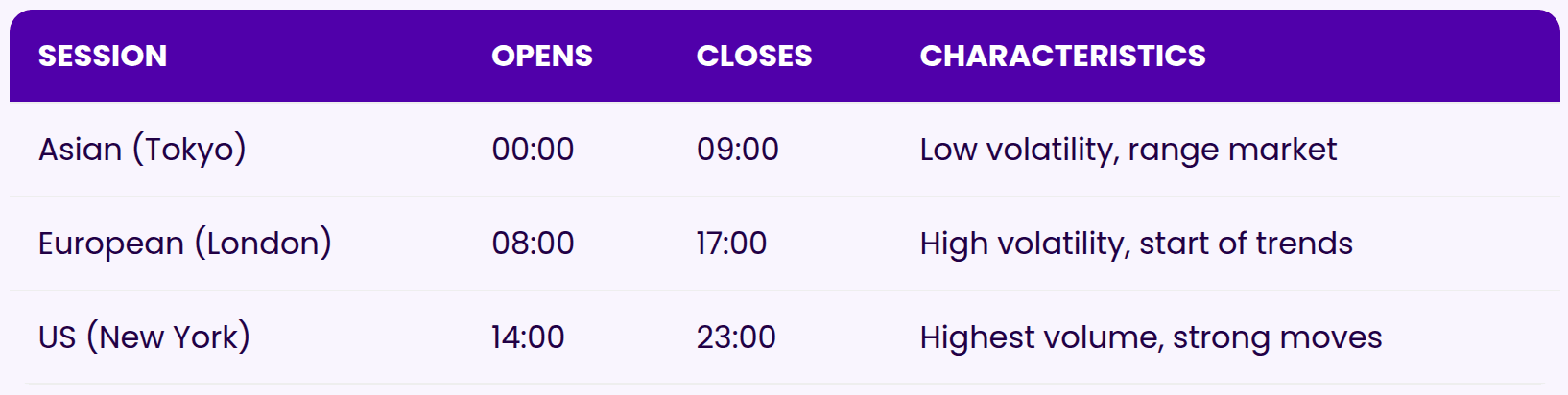
| Session | Opens | Closes | Characteristics |
|---|---|---|---|
| Asian (Tokyo) | 00:00 | 09:00 | Low volatility, range market |
| European (London) | 08:00 | 17:00 | High volatility, start of trends |
| US (New York) | 14:00 | 23:00 | Highest volume, strong moves |
Overview of Trading Sessions
⚡ Key overlaps (best trading times)
| Overlap | Time | What to expect |
|---|---|---|
| London + New York | 14:00 – 17:00 | Highest volatility (best for breakouts) |
| Asia + London | 08:00 – 09:00 | Frequent breakouts from Asian range |
Key overlaps

Core idea
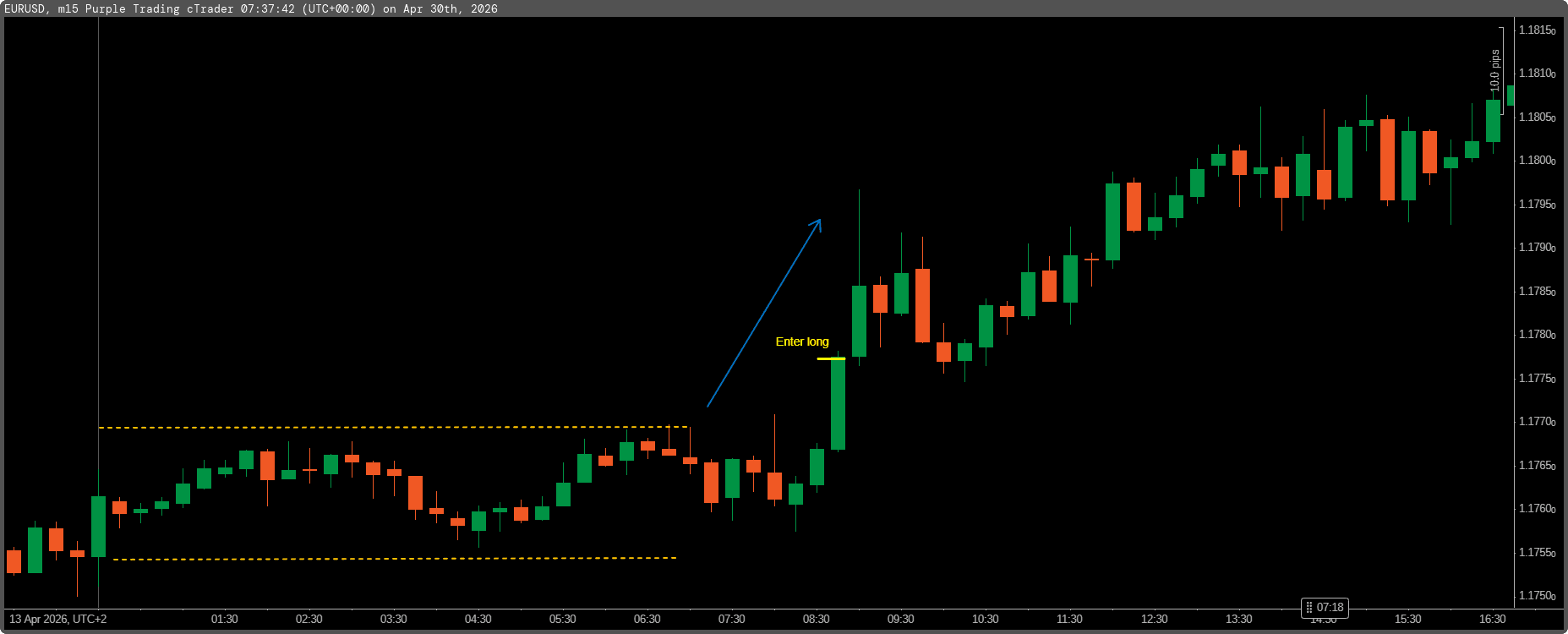
During the Asian session, the market is often calm and forms a relatively tight range. Once London opens, volatility increases and price tends to break out of that range. Your goal is to capture that move.
The principle is simple: you track the Asian range and wait for a breakout. Once price breaks one side, you enter in that direction. The stop-loss goes on the opposite side of the range and the profit target is adjusted based on current volatility.
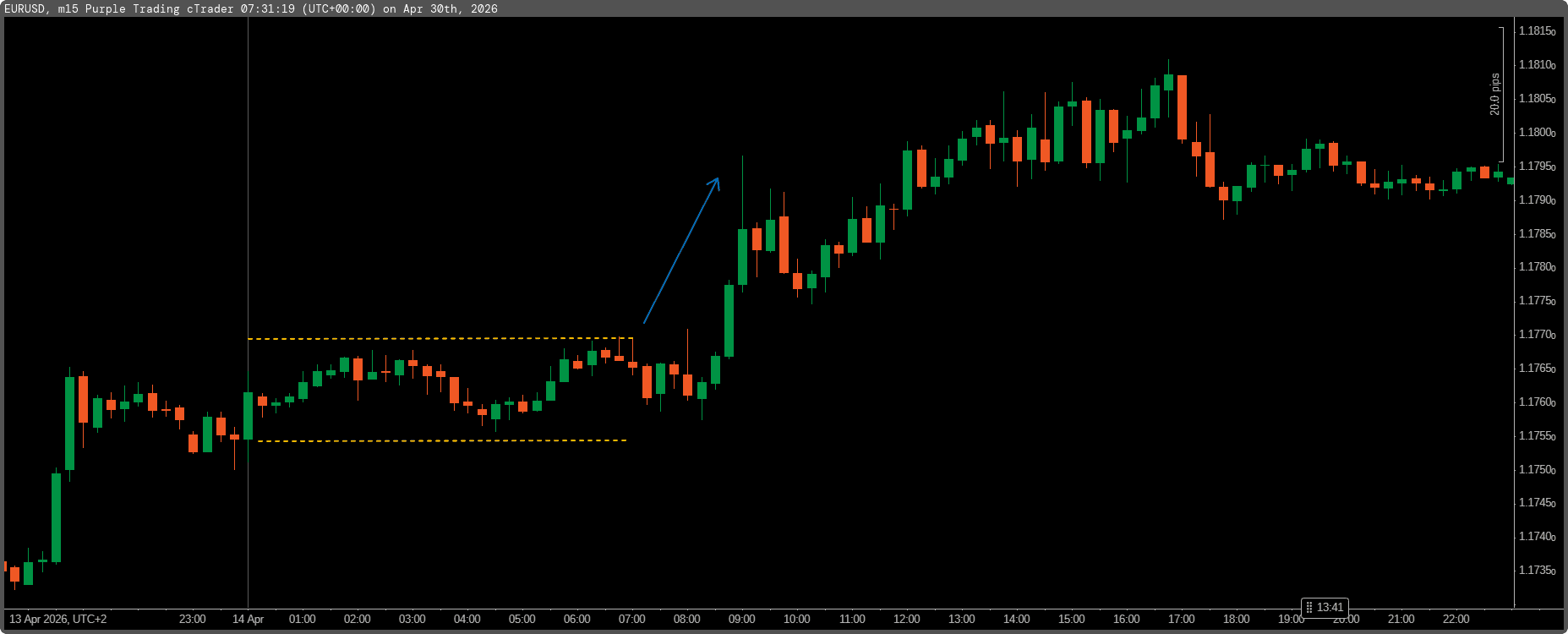
This strategy works best on trending days or when the market reacts to macro data. In sideways conditions, it can fail due to false breakouts, so selection matters.
Step-by-step process
- Mark the Asian range
Before London opens, draw the high and low from the Asian session (approx. 00:00–07:00 CET). - Wait for the London open
Around 9:00 CET, volatility increases. Don’t try to predict direction, just wait for the market to show it. - Trade the breakout
Break above → look for long
Break below → look for short
Enter after confirmation, ideally when a candle closes outside the range. - Set your risk
The stop-loss goes on the opposite side of the range. It may be wider, but it protects you from false breakouts. - Manage the trade
The profit target depends on market conditions. You can close part of the position around 1:1 and let the rest run, ideally using a trailing stop if you’re comfortable with it.
If the setup fails, stop trading
If price returns back into the range, don’t chase another trade. This is exactly where most traders break rules and exceed the daily loss limit.
💡 Fintokei tip
A trailing stop loss moves along with your profitable position. It’s a great tool if you don’t want to constantly watch the charts while still making sure you lock in the best possible result.
Best instruments
This is one of the most effective forex trading strategies when applied to major pairs.
- EUR/USD
- GBP/USD
- USD/JPY
These offer strong liquidity, clear reactions to London and New York sessions, and clean Asian ranges.
It can also work well on:
- GBP/JPY, which is more volatile,
- and on gold (XAU/USD), especially during the New York open.
Choose the platform that fits your trading DNA
We compared MetaTrader 5, cTrader and TradingView. What are their features, strengths and differences?
Why SwiftTrader
If you’re looking for how to pass a one phase challenge, this is one of the most practical virtually funded account trading strategies.
1️⃣ One-step challenge with a 6% target
- Means fast market moves can help you reach it relatively quickly.
👀 The daily loss limit is -2%,
- This makes it essential to understand:
- Position sizing for prop trading accounts.
- Keeping your risk around 0.5–1% per trade.
- Focusing only on quality setups.
- Limiting yourself to 2-3 trades per day is key..
💸 90% performance reward from each payout
Nice bonus!
💡 Fintokei tip
Which strategy to choose on ProTrader Swing? Try this one!
Strategy for StartTrader – Multi-timeframe price action
If you’re just getting started, this is one of the best trading strategies forex traders use to truly understand the market.
Core idea
The market doesn’t make sense if you look at only one timeframe. Each timeframe shows a different perspective. Higher timeframes provide context, while lower timeframes give you precise entry points.
Instead of trading random signals, you first determine the overall direction and then look for entries within that structure. The goal is not to catch tops and bottoms, but to join trends during pullbacks.
This is the approach most traders use when trying to pass a prop firm challenge on the first attempt.
Step-by-step process
- Determine the trend on a higher timeframe
Open H4 or D1 and observe price structure. If the market forms higher highs and higher lows, it’s an uptrend. If it forms lower highs and lower lows, it’s a downtrend. If it moves sideways, you simply don’t trade.
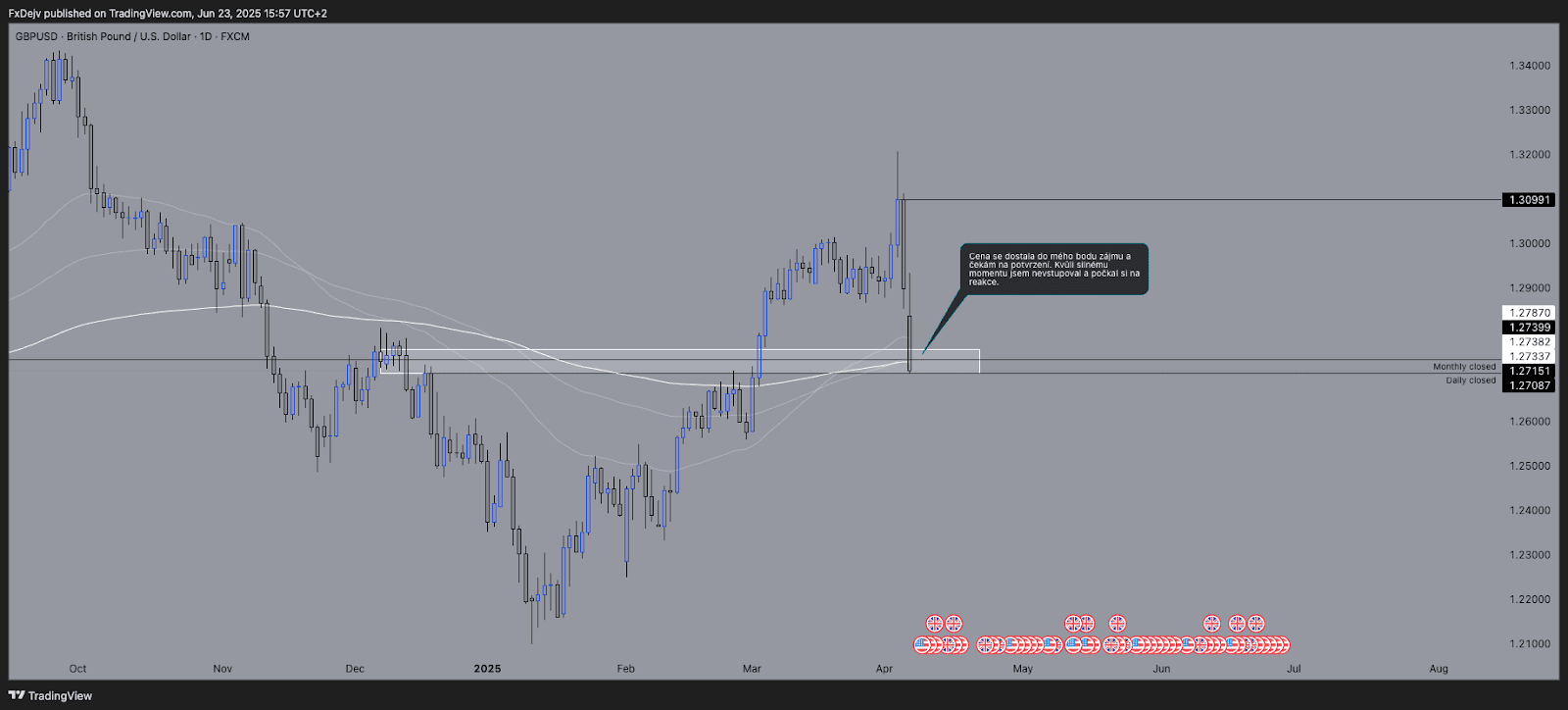
H4 chart with higher highs marked in blue and higher lows marked in red.
- Find the zone where price may return
Look for areas where price previously reacted, typically support or resistance.
- Switch to a lower timeframe
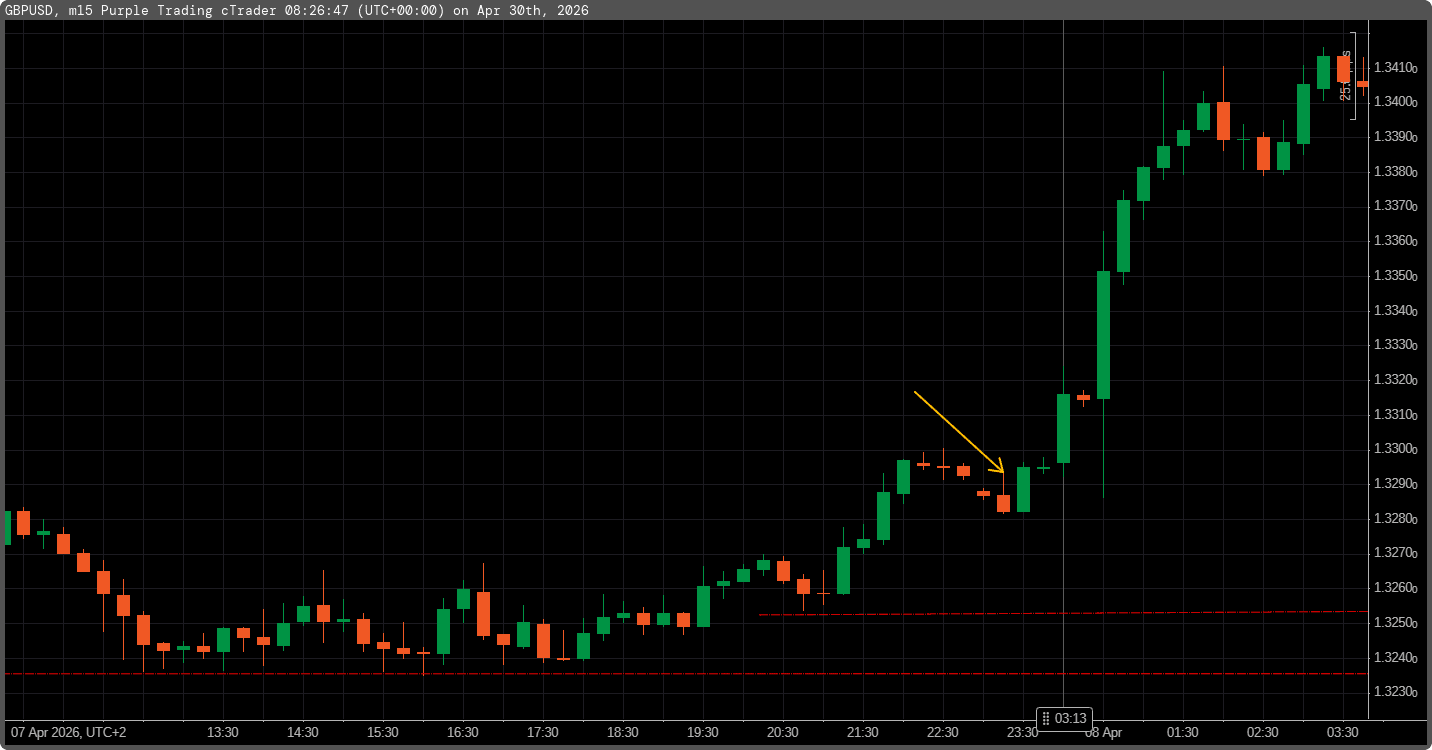
Move to M15 or M5 and observe how price behaves in that zone. You’re not rushing into a trade, you’re waiting for confirmation. - Wait for confirmation and enter
Once price starts moving back in the direction of the trend, you enter the trade.
- Set stop-loss and profit target
Place your stop-loss behind the last swing. Your target can be the previous high or low, or based on a risk-to-reward ratio such as 1:2.
💡 Fintokei tip
Learn how to set up risk-reward ratio properly.
- Trade only clean setups
If the market lacks a clear trend or behaves chaotically, you skip the trade. This is how you effectively manage risk in prop trading.
Why StartTrader
Are you just getting started with trading? This strategy is exactly for you. It combines the fundamentals of price action with precise risk management. And the ideal program for beginner traders? That’s StartTrader.
- Gradually increasing profit targets (2% | 3% | 6%)
- Max. 40% of the profit target in a single day – teaches consistency
- Once you master the basics, you can reach up to 100% performance reward (learn more about dynamic performance reward)
Thanks to this, StartTrader is the ideal environment to build trading strategies for challenges without unnecessary risk.
(phase I • II • III • StartTrader) 2% • 3% • 6% • –
(phase I • II) min 3 days, max 180 days