Best trading platforms for prop trading: MetaTrader, cTrader, DXtrade or TradeLocker?
Choosing the right platform is the first step toward prop trading success. This guide helps you pick the right one.

Before traders even pick a prop firm, they're usually comparing challenge rules, drawdown limits, and profit splits. The platform you'll actually trade on, day in and day out, matters just as much — yet it often gets overlooked until the last minute.
Let's break it down properly: which platforms do prop firms actually offer, how do they differ, and how do you pick the one that fits your trading style?
What actually determines a good prop trading platform
Not every platform is built with the same purpose in mind. Before we get into specific names, it's worth knowing what to actually look for:
- Execution speed and spreads: in prop trading, where breaching your challenge (or your funded account) is a real risk, every fraction of a pip counts.
- Algo trading support: Expert Advisors (EAs), cBots, or a connection to TradingView scripts. If you trade in an automated way, this is key for you.
- Mobile and web interface: not everyone wants to be glued to a desktop all day.
- Chart and analysis quality: especially important if you make your trading decisions manually and need more than a basic candlestick chart.
- Availability at specific prop firms: not every platform is offered by every firm. Worth checking before you commit.
💡 What's the difference between a discretionary and an algo trader?
A discretionary trader makes their own trading decisions — based on charts, news, or gut feel — and places each trade manually. An algo trader instead uses a programmed trading robot (an Expert Advisor, or automated trading system) that trades according to preset rules, without the trader stepping in.
Trading platforms you'll come across at prop firms
MetaTrader 4 (MT4)
A classic that traders have sworn by for over 20 years. MT4 is simple, stable, and extremely widely used — you'll find thousands of tutorials, indicators, and ready-made EAs for it. The downside is a somewhat dated interface and more limited backtesting compared to newer platforms.
MetaTrader 5 (MT5)
MT4's successor, with an improved strategy tester, more timeframes, and better market depth. Many prop firms today prefer MT5 for its more modern infrastructure, even though plenty of traders stick with MT4 out of habit.
cTrader
A favorite among the algo trading crowd. The C# language used for cBots is more approachable than MQL, and the interface feels noticeably fresher than MetaTrader's. cTrader also shows you the orders waiting above and below the current price (known as market depth), which fast traders find useful. On top of that, cTrader stands out for its advanced risk management tools — something you genuinely want when trading a prop account.
TradingView
Originally an analysis tool, now a full trading platform once you connect it to the right broker. Its strength is the community (shared scripts, indicators, ideas) and simply having the best-looking charts around. For traders who spend hours studying charts, TradingView is often the obvious pick. 📈
DXtrade
A cloud-based platform from Devexperts, used by a growing number of newer prop firms. Its strengths are a modern architecture and good scalability for firms handling large numbers of accounts; the tradeoff is somewhat smaller community support and fewer third-party tools compared to MetaTrader.
Match-Trader
A platform built primarily for prop trading and retail brokers, focused on simplicity and fast onboarding. It has a solid mobile app, but when it comes to advanced algo trading, it doesn't yet match cTrader or MT5.
TradeLocker
The newcomer of the group, making its name mainly through a modern web app and quick rollout at both smaller and larger prop firms. It's still missing the long track record and large community that MetaTrader has, but its development team is actively building it out.
Platform comparison at a glance
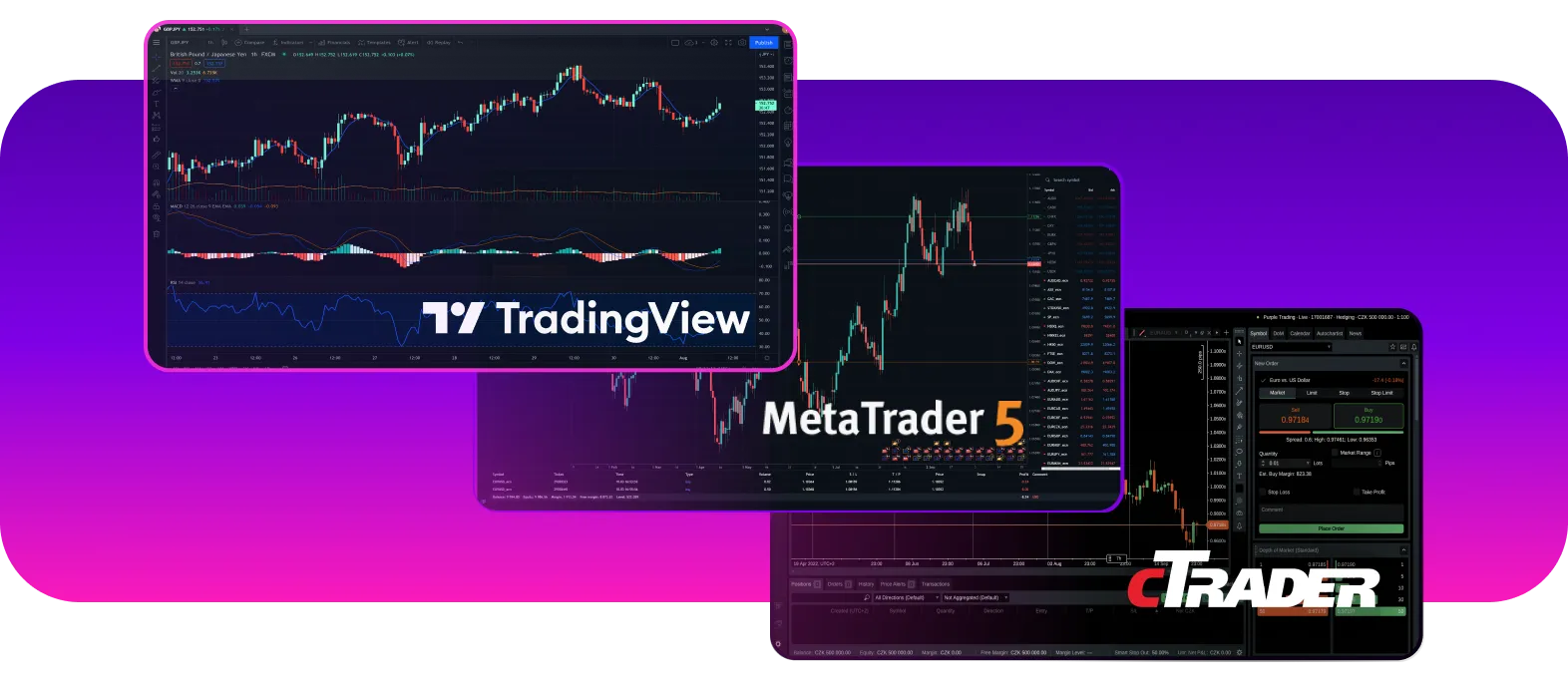
Which platforms does Fintokei offer, and why
At Fintokei, you can choose between MetaTrader 5, cTrader, and TradingView — and that's not a coincidence. 🎯
- MetaTrader 5 is here for traders who want proven infrastructure and access to a huge library of EAs and indicators.
- cTrader is the choice for anyone building on algo trading: cBots in C# are easier to code than MQL, and execution is fast and transparent.
- TradingView gives you the best of both worlds: top-tier charts and analytical tools from the TradingView community, connected directly to execution on your Fintokei account (via cTrader).
This combination covers both traders who make their own calls based on charts and those who trade in a fully automated way — without any compromise on execution quality.
Pick the platform that fits your trading DNA
We compared MetaTrader 5, cTrader and TradingView — their features, strengths and differences.
How to choose a platform based on your trading style
- Scalper / day trader → cTrader (fast execution, market depth) or TradingView (quick visual orientation).
- Swing trader → MetaTrader 5 or TradingView, where you'll appreciate more timeframes and deeper analysis.
- Algo trader → cTrader (cBots in C#) or MetaTrader (EAs in MQL), depending on which coding language suits you better.
- Traders who love community input and shared ideas → TradingView, hands down.
There's no single, universally "best" platform — only the best one for your specific trading style.
Want to see it live, with real examples?
Frequently Asked Questions
What is the best trading platform for prop trading?
It depends on your trading style. For automated trading, cTrader or MetaTrader are usually the top picks; for traders who make their own calls and want the best charts, TradingView.
Do prop firms support TradingView?
Not all of them, but Fintokei does. You can connect TradingView directly to your cTrader account and start your trading challenge using its charts and tools.
Is cTrader better than MetaTrader for prop trading?
Neither is universally "better." cTrader has a more modern interface and a simpler coding language for algo trading (C# vs. MQL), while MetaTrader benefits from a huge community and a massive library of ready-made tools.
Can you use automated trading on prop trading platforms?
Yes, in most cases. At Fintokei, algo trading is fully supported on both cTrader (cBots) and MetaTrader 5 (EAs).
What's the difference between a discretionary and an algo trader?
A discretionary trader makes their own trading decisions — based on charts, news, or gut feel — and places each trade manually. An algo trader uses a programmed trading robot that trades according to preset rules, without their involvement.

I make sure our support team is always there when traders need it. I trade too: sticking with a classic: EURUSD. I reset after both green and red days, either by keeping a steady breathing rhythm on a run or holding my breath over a historical novel in a café. Favorite platform: MetaTrader 5. Favorite challenge: SwiftTrader.