Are prop firms legit, or is it all one big scam?
Prop firms promise capital, freedom, and a fast start to your trading career. But over the past two years, more than a hundred of them vanished — along with traders' money. So how do you know if the firm you're about to pay for a challenge actually plays fair? Here are 10 red flags to watch for, and what an honest approach actually looks like.
Ask Google or ChatGPT if prop firms are legit, and you'll get thousands of answers. Almost none of them will tell you how to check for yourself. Prop trading has grown from a niche curiosity into a billion-dollar business over the past four years. And as usual, that growth attracted plenty of firms that just wanted to take your challenge fee and disappear.
Between February 2024 and the end of 2025, an estimated 80 to 100 prop firms shut down. That's roughly one in seven firms on the market. Some collapsed due to technical issues with brokers, others were scams from day one.
So, is prop trading a scam? There's no simple yes/no answer. Prop trading as a model makes sense, and plenty of firms run honestly and for the long haul. At the same time, it's an industry with no unified regulation, which leaves room for firms that operate more like a marketing funnel than an actual business. We'll show you what to watch out for, and what an honest approach looks like in practice 👇
What a scam actually looks like from the inside
A legit prop firm makes most of its money because 95–98% of challenge applicants don't pass (at Fintokei, that number is a bit lower — 23% of people pass the challenge). Fees from failed attempts fund the payouts for the minority who succeed and become funded traders. It's a sustainable model, as long as the firm has enough capital and manages it responsibly.
A scam version looks almost identical from the outside. What's missing is one key thing: any real intention to pay. Typical scenario: you pay the evaluation fee, get a demo account, and even after passing the challenge, you're still just trading on a demo — except the firm never tells you that. And the payouts? They either never get approved, or they keep getting delayed, one excuse after another.
There have been more of these cases over the past two years than you'd expect. One firm invented tens of millions of dollars in fake payouts. Another built its reputation on thousands of reviews published before the company even existed. A third retroactively changed its rules just to reject withdrawals it had already approved.
Start a challenge with a firm that's got 15 years of history behind it.
10 red flags that warn you before you pay
Before you pay for a challenge with any prop firm, run through this list. No single point automatically means a scam. But the more of them apply, the bigger the risk.
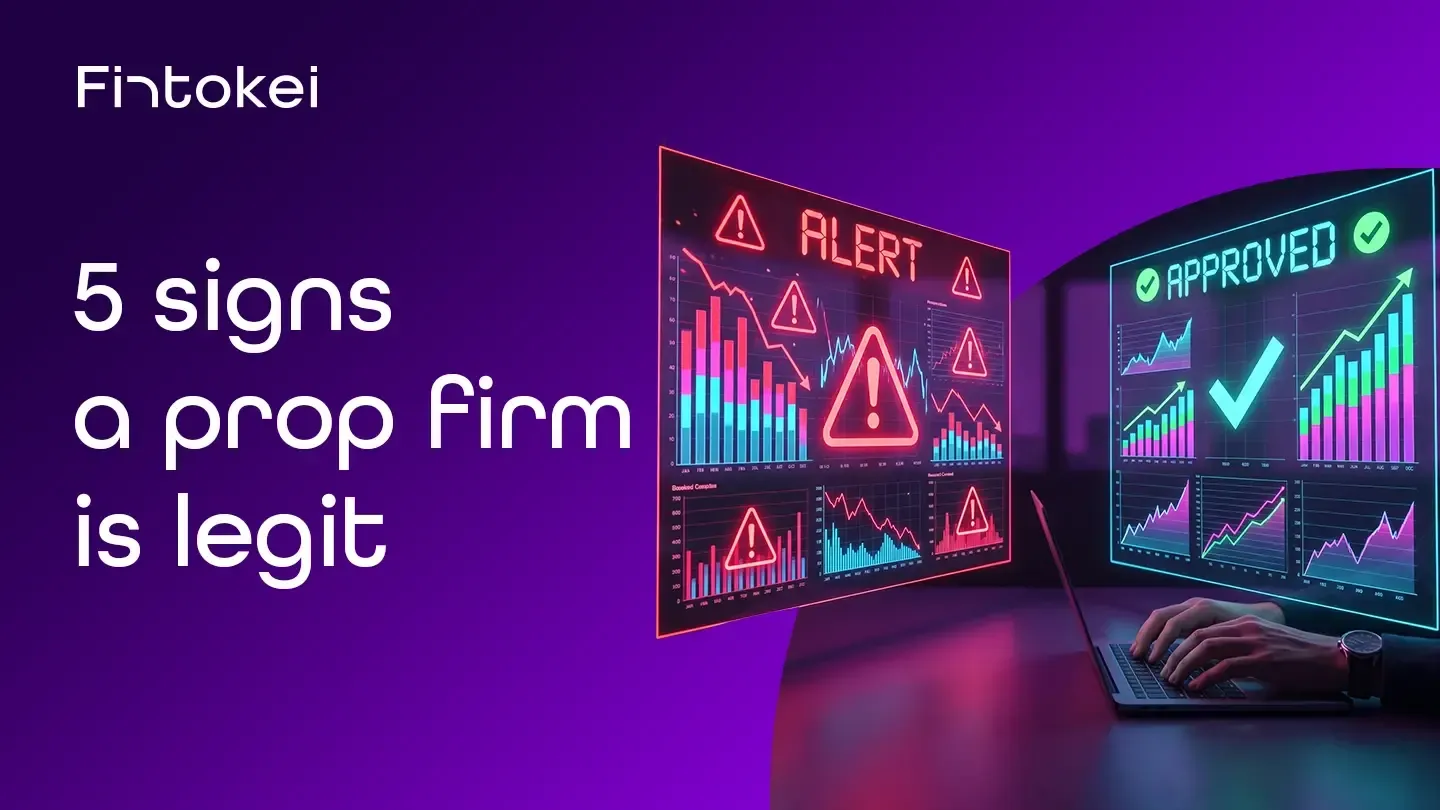
- 🚩 The challenge price is well below the market standard (for a two-phase $100K challenge, half the usual ~$500 or less) — the firm may not have the capital to cover payouts.
- 🚩 Guaranteed profit or "risk-free" trading. No legit firm can guarantee you profit.
- 🚩 The rules only show up after you pay, buried in the fine print or a PDF you only get post-purchase.
- 🚩 The firm wants you to open and fund a real trading account yourself. The challenge is supposed to run on a demo — an entry fee is normal, funding a live account isn't.
- 🚩 Identity verification (KYC) only gets requested once you try to withdraw money.
- 🚩 You can't find the founders' names, the company's registered address, or even its official legal name anywhere.
- 🚩 Unrealistic terms, like a 20% profit target with a 3% daily drawdown — that combination is close to mathematically impossible.
- 🚩 Reviews that all look identical and appeared at the same time — a classic sign of bought reviews.
- 🚩 Vague wording like "rule violation at the company's discretion," with no concrete explanation of what's actually allowed.
- 🚩 No independent proof of payouts — just screenshots and quotes on the firm's own website.
And how to tell a firm actually plays fair
What about regulation? What applies and what doesn't
Prop trading as an industry currently has no unified regulation, in the EU or anywhere else in the world. Firms that only evaluate traders' skills on demo accounts, and don't hold client funds or provide investment services, generally don't fall under financial regulators' oversight. That's a normal legal reality, not a loophole someone's exploiting.
What matters is telling two things apart: the prop firm itself (challenges, payouts) and the broker or financial infrastructure it actually trades through and sends money via. If a prop firm is connected to a regulated broker or financial group, it indirectly benefits from a higher standard of security and stability — even if the prop firm itself isn't regulated, and doesn't need to be.
How Fintokei handles transparency
Fintokei is a good example of dealing with the regulation-and-trust question head-on, instead of hiding or dressing it up.
At Fintokei, we openly say that we're currently not a regulated financial institution.
And we explain exactly why:
- we don't provide regulated investment services,
- we don't collect client deposits,
- and we don't facilitate real trading transactions for clients.
With us, you trade on a demo account during the evaluation. We then send your payout from our own funds. That kind of open admission is a good sign in itself. Scam firms, by contrast, tend to either hide their regulatory status or claim licenses they don't actually have.
Fintokei also isn't a project without history or backing. We're part of Purple Holding, a fintech group with roots going back to 2007, which today employs over 250 people and includes Purple Trading — a fully regulated CFD/forex broker licensed by CySEC and authorized by the Czech National Bank, subject to client fund segregation and regular audits.
So Fintokei itself isn't regulated, but it draws on the security standards and years of history from the regulated part of the group.
A few more concrete things you can check yourself:
- ✅ Registered company, Fintokei s.r.o., based in Czechia — not an anonymous entity at an offshore address.
- ✅ Publicly known leadership: co-founder David Varga appears under his own name in interviews (including on FXstreet.cz), including candid conversations about industry risks and collapses.
- ✅ The terms for every program (profit target, max drawdown, minimum trading days) are public on the website before you buy a challenge.
- ✅ We approve your payout in seconds, and the money reaches you within hours. That's exactly how specifically we communicate it at Fintokei — not just with the word "fast."
- ✅ You'll find independent reviews on Trustpilot or Traders Union, not just on the company's own website.
Start a challenge with a firm that's got 15 years of history behind it.
A 5-minute checklist that could save you thousands
Before you pay for any prop firm, check:
- Can you find a registered company and its address? (not just a logo and a tagline)
- Do you know the name of at least one person publicly behind the firm?
- Can you see the full evaluation rules before you pay?
- Are there independent reviews outside the firm's own website?
- Does the firm tell you straight up whether it's regulated, and why (or why not)?
- Does the firm communicate payout speed specifically (how many hours, how many days), not just with the word "fast"?
Prop trading as a model works, and it's genuinely opened the door to a trading career for plenty of people who couldn't otherwise afford the capital. But the question "is it a scam" has to be asked about a specific firm, not the whole industry. A firm that tells you straight up what it is and isn't, who's behind it, and exactly how payouts work, is doing the best advertising for itself — without a single promise of guaranteed profit.

I make sure our support team is always there when traders need it. I trade too: sticking with a classic: EURUSD. I reset after both green and red days, either by keeping a steady breathing rhythm on a run or holding my breath over a historical novel in a café. Favorite platform: MetaTrader 5. Favorite challenge: SwiftTrader.