Which prop firm pays the most? What performance reward ratio really means
The short answer for 2026: no prop firm pays “the most” on its own. How much ends up in your account depends on the performance reward ratio, the account size, the loss limits and how often you can request a payout. A high percentage won't help you if you can't stick to the rules and never reach a payout at all.
The short answer for 2026: no prop firm pays “the most” on its own. How much ends up in your account depends on the performance reward ratio, the account size, the loss limits and how often you can request a payout. A high percentage won't help you if you can't stick to the rules and never reach a payout at all.
Key takeaways:
- The firm that pays the most isn't the one with the highest percentage, but the one where you can realistically reach a payout.
- Performance reward ratio is the share of your result on a virtually funded account that you receive as a reward.
- Your payout depends on account size, your result and the performance reward ratio – but also on loss limits and payout frequency.
- With “100%” offers, check whether they're permanent and what rules come with them.
- At Fintokei, the performance reward ratio is 80–90% and can grow through the Loyalty Program.
Comparison sites keep repeating numbers like “up to 90%” or “100%”. They look clear, but on their own they say almost nothing. In this article, we'll show you what performance reward ratio really means, why the percentage alone is misleading and how to compare payouts between firms fairly.
What is performance reward ratio
Performance reward ratio is the share of your result on a virtually funded account that you receive as a reward. If your ratio is 80% and you make 1,000 USD on the account, your reward is 800 USD.
Why don't we talk about splitting profits? Because with a prop firm, you trade virtual capital. Your trades aren't executed with real money on the market, so there's no real profit to split between you and the firm. The firm pays you a reward for your performance – and the performance reward ratio tells you how much of your result goes into that reward. It's a more accurate and more honest name for what's actually happening.
Why the percentage alone is misleading
The percentage only tells you what share of your result you get. It says nothing about how big the account is or how likely you are to reach a payout at all.
Let's show it on two made-up firms. The numbers are purely illustrative and don't describe any real prop firm.
Example (illustrative numbers):
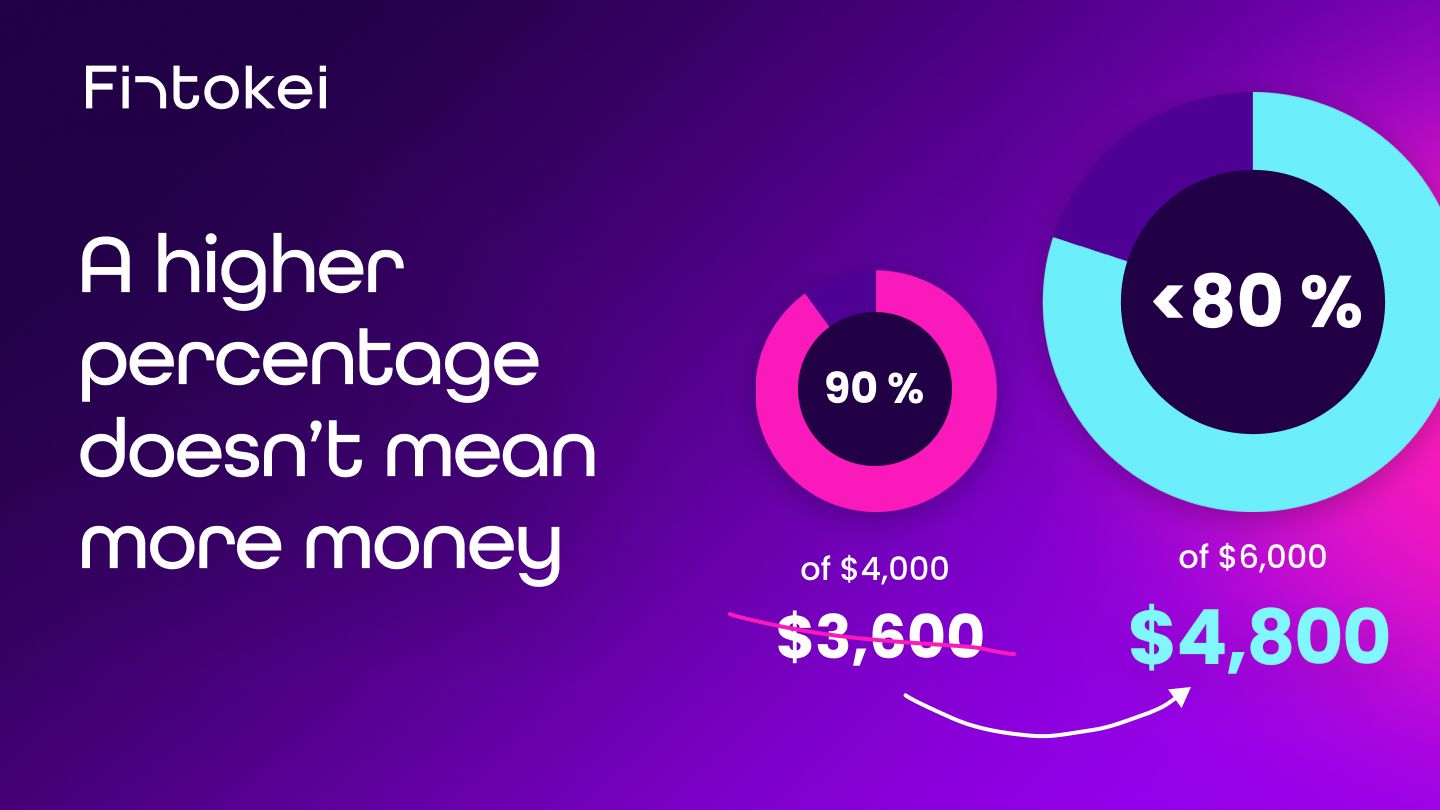
The firm that pays the most isn't the one with the highest percentage, but the one where you can realistically reach a payout
Same performance, a “worse” percentage – and still an eight times bigger reward. The reason is simple: 80% of 4,000 USD is more than 100% of 400 USD.
Now imagine a second scenario. Things aren't going your way and the account is down 7% for a while before your trades turn around. At Firm A, that breaks the loss limit – the account is over and the payout is zero, whatever the percentage. At Firm B, you still have room and can finish the period in profit.
What else decides how much you get
Your payout comes from the whole “equation”: account size × your result × performance reward ratio – plus the rules that decide whether you get to a payout at all. What to look at:
- Account size. The percentage is calculated from your result, and your result from the account size. The bigger the account, the bigger the amount for the same performance.
- Loss limits. Daily and maximum loss limits decide how much room you have for bad days. Limits that are too tight mean a higher risk of losing the account before you get to a payout.
- Minimum result for a payout. Some programs require a certain result before you can request a payout. It's good to know this upfront.
- Payout frequency and speed. How often you can request a payout and how long it takes for the money to arrive. You'll find more in the article Which prop firm has the fastest payout.
- Scaling and boosts. Some firms will give you a bigger account or raise your performance reward ratio when you get good results. In the long run, this can matter more than the starting percentage.
- Other conditions. Limits on open risk, consistency rules or a payout cap on some programs – all of these affect the final amount.
💡 Fintokei tip
We've worked out what this looks like in practice on a specific program in the article How much SwiftTrader can really earn you.
“100%” offers – when they make sense and what to ask
A 100% performance reward ratio can be a good deal, but only if the other conditions fit too. It's often a time-limited promotion or tied to a specific program.
Before you get excited about “100%”, ask yourself a few questions:
- Does 100% apply to all payouts, or just the first one?
- Is it a permanent feature of the program, or a promotion with an end date?
- What are the program's rules – loss limits, minimum result for a payout, account size?
- Is the higher percentage “balanced out” by a pricier challenge, a smaller account or less frequent payouts?
- Is there a cap on how much the firm can pay you at once?
If you find a clear answer to all of these in the terms and the numbers add up, it's a good offer. If not, treat it more as marketing than as a guarantee of a bigger payout.
More questions about payouts?
Ask BonsAI, our AI assistant. It'll answer your questions about programs, rules and payouts right away.
How it works at Fintokei
At Fintokei, the performance reward ratio differs by program and can grow over time thanks to the Loyalty Program. You can request a payout once every 14 days and all programs have instant payouts – your request is approved right away and the money usually goes out within about 3–5 hours.
In the Loyalty Program, you collect points for your activity, and with each new level your performance reward ratio can go up. You'll always find the current numbers for all programs on the Payouts page.
💡 Fintokei tip
Our article A record year for Fintokei: almost half of all payouts happened in 2025 shows that payouts really do happen. For real traders' stories and payouts, check out Trading as a career: TOP 10 ProTraders earn in one payout what others make in a year.
How to compare payouts between firms – a checklist
Don't compare one number, compare the whole package. Go through these points for every firm:
- Performance reward ratio – what percentage of your result you get and whether it changes over time.
- Account size and challenge price – how big the account your reward is calculated from is, and how much you pay for it.
- Loss limits – daily and maximum, and whether they're calculated from equity or balance.
- Minimum result for a payout – do you need a certain result before you can request a payout?
- Payout frequency – how often you can request one.
- Payout speed – how long approval and sending the money take.
- Payout cap – is there a limit on how much the firm will pay you?
- Boosts – can you get a bigger account or a higher ratio?
- Promotion terms – does the better percentage apply permanently, or only for a limited time?
Once you write these points down side by side, you'll quickly see that the firm with the highest number in its ads isn't necessarily the one that ends up paying you the most.
Curious what's inside?
Create a free account and explore the Fintokei zone — loyalty rewards, dashboards, refer a friend and more. No challenge required.
Frequently asked questions
Which prop firm pays the most?
You can't tell from a single number. Your payout depends on the performance reward ratio, account size, loss limits, payout frequency and whether you can stick to the rules. Compare the whole package of conditions, not just the percentage.
What is performance reward ratio?
It's the share of your result on a virtually funded account that you receive as a reward. With an 80% ratio and a 1,000 USD result, your reward is 800 USD.
Is there a prop firm with a 100% performance reward ratio?
Some firms offer a 100% performance reward ratio – either permanently on a specific program or as a time-limited promotion, for example on your first payout. Always check in the terms which payouts it applies to, what the program's rules are and whether the payout has a cap.
How big a payout can I get from prop trading?
It depends on the account size, your result and the performance reward ratio. For example, with a 100,000 USD account, a +4% result and an 80% ratio, the reward would be 3,200 USD (illustrative calculation). But no payout amount is guaranteed – it all comes down to your performance and sticking to the rules.
Is a higher percentage always better?
No. A higher performance reward ratio won't help you if it comes with a smaller account, stricter loss limits or less frequent payouts. Sometimes a lower percentage on a bigger account with more reasonable rules works out much better.

Part of the support team, focused on solving your issue before you even type “payout.” Outside of work, you’ll probably find me in a park with a book or sitting in a cinema, quietly analyzing the plot like it’s a price chart. Favorite platform: MetaTrader. Favorite challenge: ProTrader.