“The important thing is to survive long-term, not make money fast,” says Michal, a Fintokei Star from Czechia
From random scrolling on social media to consistent payouts. Michal’s journey proves that trading is not a sprint, but a marathon.

A scalper, IT specialist and practical-minded trader who went through the classic beginner mistakes and questionable education communities before finally finding his own style: DAX, range bars and 0.25% risk per trade. We talked about how to stay in control, avoid falling for myths about the holy grail, and why he believes even small percentages can mean big money.
- How did education communities promising quick success almost destroy him?
- What was the moment that showed him prop trading really works?
- Why does he trade on the “legendary” MT4 and have no plans to change it?
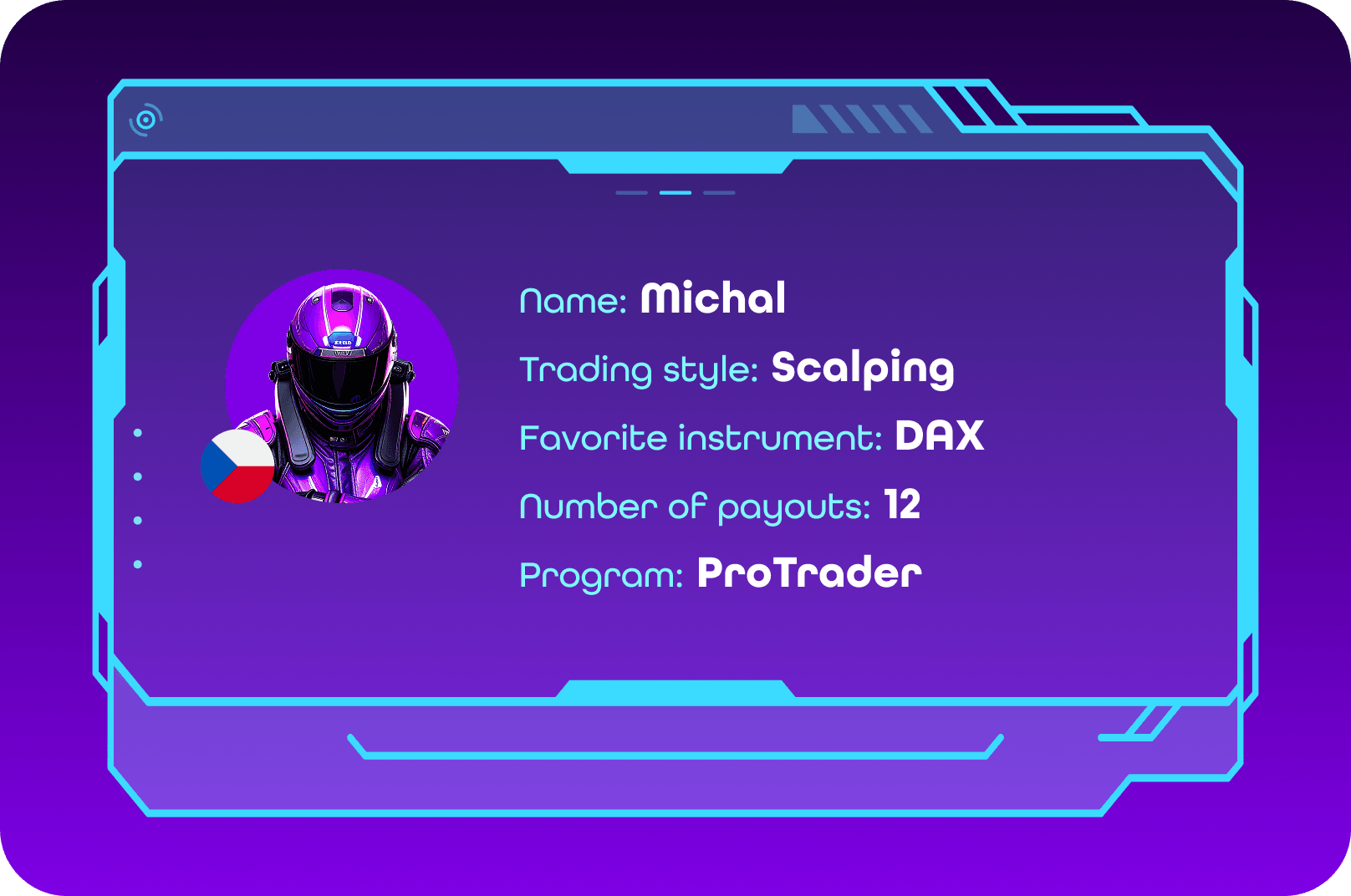
“At that moment, I realized this might be the path I wanted to try.”
Hi Michal, how did you actually get into trading? What was the first impulse?
It started completely by chance a few years ago. Trading began appearing more and more on social media, and I kept coming across it. It wasn’t really the videos themselves that grabbed me, but more the idea of financial independence and having more control over my income. I became interested in how markets work and gradually started diving deeper into it.
And the beginning? I bet it wasn’t all smooth sailing.
At the beginning, I had the classic “beginner’s luck.” A few trades worked out and I felt like I had figured it out. I even got a call from the company where I had my account because they saw I was doing well. But just as quickly as the profits came, they disappeared. I took on too much risk and lost everything.
That sounds like the classic first lesson. What came next?
Then came the era of various education communities, such as IM Academy, which promised quick success. Honestly, I got pulled in a bit. They helped me, for example, set up an account with Purple Trading, where I got my first taste of real trading. But I quickly realized that their business model wasn’t primarily about trading. The Czech National Bank later warned about them as well. So I decided to go my own way.
And how did you keep looking for your own path? What did you go through?
It started with the classic chase for the holy grail. Finding the perfect indicator or EA. I tried hundreds of them, went through the entire MQL5 forum, tried programming them myself…
And of course, nothing worked. Gradually, I realized I had been pretty naive. I started thinking about trading more systematically and discovered that I didn’t actually need dozens of indicators.
And what about trading knowledge? Where did you get it from, especially after getting burned by that community?
I mainly learn from the internet. There isn’t a day when I don’t watch some trading video or come across something on social media.
But the webinars from Purple Trading helped me a lot, especially Trading Room with Mr. Tupý. It’s great to watch an experienced trader think about the market live and have the chance to ask anything. A big thanks goes to them for that.
You can find a few experienced traders on YouTube and elsewhere who share their experience. Even if their trading style often isn’t exactly mine, I can always take something from it that moves me forward.
Sometimes I also listen to different podcasts. For example, the wordsofrizdom account on Instagram and YouTube has interesting interviews and views on trading and mindset.
Ready to try the best one-step prop challenge?
Start your SwiftTrader challenge today and trade toward your first payout.
“I was really excited. In my head, I was already browsing cars.”
Do you remember your first major trade? The one after which you said: ‘Yes, this works’?
I don’t remember my very first trade, but I do remember my first bigger profit. It was on the Dow Jones at the beginning of Covid. The markets were falling, so all you had to do was short and wait. But as usually happens in the beginning, I wanted more and more, took unnecessary risk, then a correction came and the account was gone.
What was the turning point that showed you prop firms were the way to go?
I’d say there were at least two key moments. The first was when I discovered that prop firms existed at all. That completely changed my view of trading. And the second was my first payout. At that moment, I realized it really worked and that it wasn’t some scam.
And how did you react to that first payout? I have to admit, I’m curious about the human side of it.
😀 I was really excited. In my head, I immediately started browsing cars and thinking about what I could buy in a few months if it kept going like this. The classic reaction.
Free Ebook: Master Your Emotions, Master the Markets 🧠
Trading success is 80% mental. Ditch the fear of loss and uncontrolled euphoria to build the discipline of a pro. Download our e-book and discover the mindset of the world’s top 10% traders.
“Traders don’t like DAX that much, but it suits me.”
How would you describe your trading style today?
I’m definitely a scalper. I tried different styles, but I always came back to short-term trades. Long-term predictions don’t suit me. Markets today react to every piece of news, and Trump can really shake them up 😀, so I prefer reacting to the current movement. I mainly trade DAX and use range bars, which give me a cleaner view of the market. My trades last from a few seconds to a few minutes.
And what about the key part: risk management. How do you approach it?
I used to struggle a lot with risk. Today, I always have a stop-loss set and I risk around 0.25% per trade, sometimes even less. I do set my take-profit in advance, but I often manage it based on the situation. I move it or take profit earlier. I’m not chasing big percentages. The important thing is to survive long-term, not make money fast.
💡 Fintokei tip: Stop Loss is your best friend
Once you know the limit you must not exceed, setting a stop loss becomes the simplest and most effective solution. A bit of calculation, a few clicks, and your risk is under control.
What platform do you trade on?
😀 Yes, I trade on the “legendary” MT4. When I first saw it, I felt like I had gone back to the last century. But over time, I realized it has its charm and, most importantly, it simply suits me. What also keeps me on it is that I have a few of my own indicators built specifically for MT4, and I don’t have the source code for them. Today, with AI, it would probably be easier to rewrite them, but MT4 works for me and I have no reason to change it.
Can you briefly walk us through one of your best trades with Fintokei?
Sure. It probably won’t be my best trade ever, but I’ll show you one from recently. It was a trade on DAX, where the market was in an uptrend. After a small correction, the price pulled back to the EMA and the indicator marked support there. I entered when momentum returned back into the trend, the stop-loss was placed below the local low, and the target was aimed at the previous high.
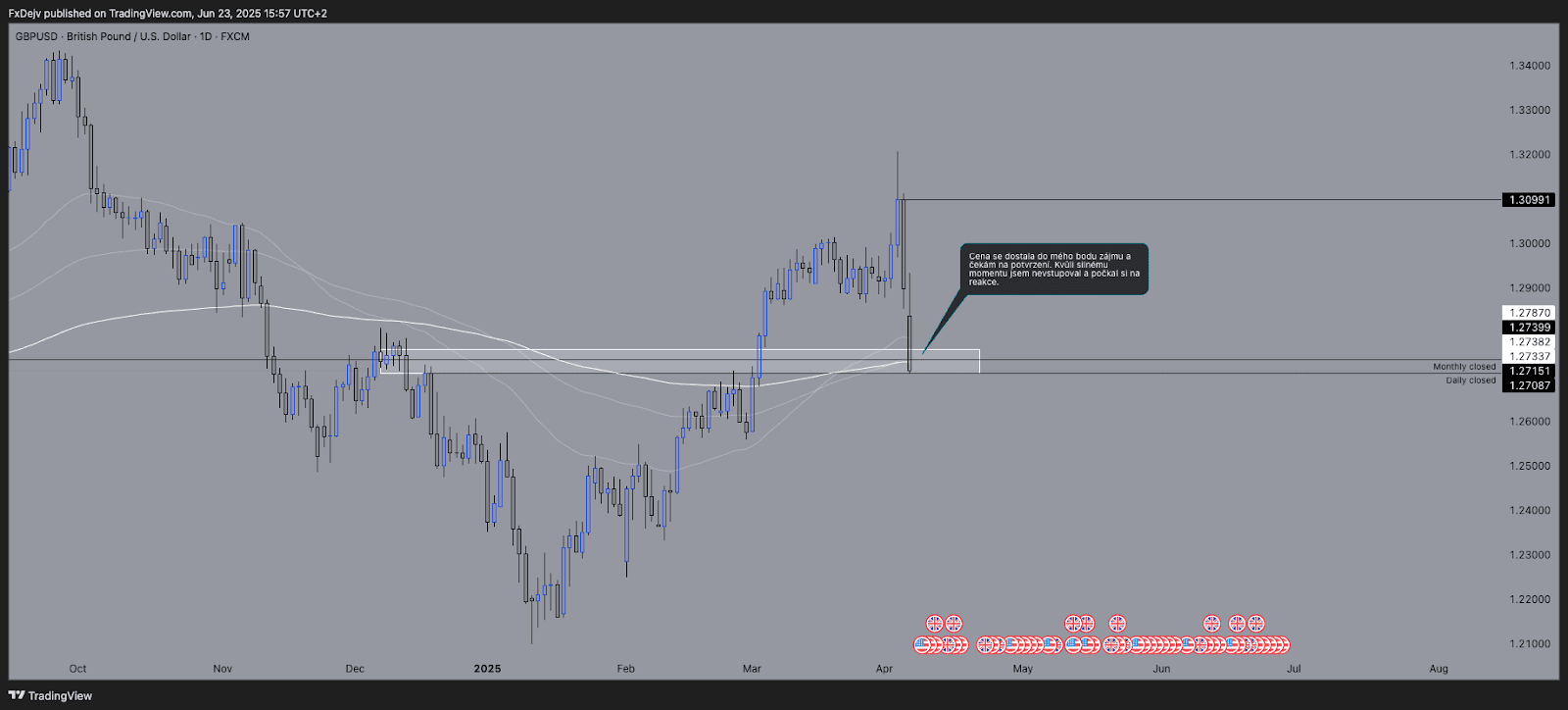
Nothing too fancy. Pure technical analysis with a bit of intuition. But everything lined up, so I entered.
“My girlfriend told me I was starting to go grey from it.”
How do you deal with stress? Scalping must be pretty intense.
I used to get very stressed. My girlfriend even told me I was starting to go grey from it. 😀 But over time, I reduced my risk, and that reduced the stress too. Today, when I risk relatively small amounts compared to the account size, I’m much calmer. With scalping, though, it’s still hard to pull yourself away from the charts, especially when things aren’t going well. You make decisions quickly, and making sure you don’t slip into revenge trading isn’t always easy.
And losses? How do you work with them?
I used to try to “make them back” immediately, which only led to more losses. Over time, I understood that losses are part of trading. Today, I take them as a normal thing. I write the trade down and continue according to the plan. Emotions are still there sometimes, especially with scalping, but when I feel I’m not in the right state, I’d rather turn off the platform and take a break.
What does your typical trading day look like?
I wake up around 8:20, check my work, look at the economic calendar and wait for DAX to open. I usually start trading around 15 minutes after the open and continue until roughly 10 o’clock. Combining work and trading can be challenging sometimes — especially when you have a meeting and MT4 running on the third monitor. But I’ve learned not to enter trades in those moments. 😀
💡 Fintokei tip
Do you know the four emotions that can destroy your prop trading results? Read this article.
“There is no holy grail. It’s about discipline, mindset and long-term consistency.”
What do you think is the biggest myth about trading?
The biggest myth is making dozens of percent per month. In the short term, it might be possible, but long-term it’s not sustainable. Just look at the top traders. Even they don’t make hundreds of percent per year. And then, of course, there’s the myth that a holy grail exists. It doesn’t. It’s about discipline, mindset and consistency.
And what made you try Fintokei specifically?
I had been following Purple Trading for a long time, so I noticed when Fintokei launched. I was motivated by the more reasonable challenge conditions, and especially the connection with Purple Trading, which gave me more confidence that it would be serious.
And one final question. If you could give one piece of advice to a beginner trader, what would it be?
It’s better to gradually increase capital than to increase risk. Even 2% per month can mean very interesting money in a relatively short time. It all depends on the base you’re working with. In the end, patience and consistency beat everything.
Michal, thank you for the open interview and we wish you many successful trades!
Want to find out how your routine would hold up?
Choose the program that fits your style and try it in a Fintokei challenge.
Plus, get 20% off your first challenge with code NEW20